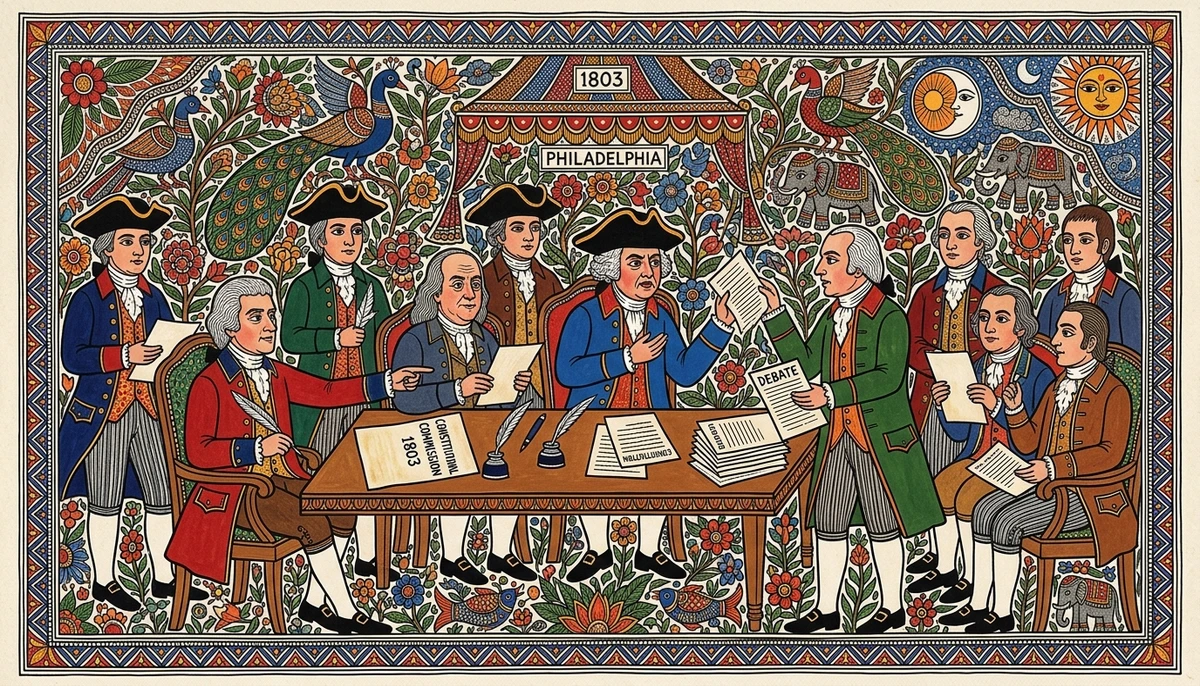
Marbury v. Madison (1803): The Case That Made Courts the Final Arbiter
Marbury v. Madison (1803): The Case That Made Courts the Final Arbiter
Few legal decisions have reshaped constitutional government more fundamentally than a case decided by a court that, in the end, ruled against the very petitioner who brought it. Marbury v. Madison, decided by Chief Justice John Marshall in 1803, did not free William Marbury or deliver him his judicial commission. What it did instead was establish that the Supreme Court of the United States had the power to strike down any law that conflicted with the Constitution — a power known as judicial review. That holding has since become the bedrock of constitutional democracy across the world.
The Political Crisis of 1800
To understand Marbury, you have to understand the ferocious politics of the early American republic. The election of 1800 was one of the most bitter in American history. The Federalists, the party of George Washington and John Adams, were defeated by Thomas Jefferson and his Democratic-Republicans. For the Federalists, this felt like catastrophe. They believed Jefferson’s party would dismantle the strong national government they had built.
Between losing the election in November 1800 and Jefferson’s inauguration in March 1801, the outgoing Adams administration worked frantically to entrench Federalist influence. Congress passed the Judiciary Act of 1801, creating dozens of new federal judicial positions. Adams filled them with loyal Federalists. In the final days and hours of his presidency, he signed commissions for 42 justices of the peace for the District of Columbia — appointments so rushed they became known as the “midnight appointments.”
John Marshall, then serving as Adams’ Secretary of State, was responsible for delivering those commissions. He was also, simultaneously, the newly confirmed Chief Justice of the Supreme Court. In the chaos of the final hours, some commissions were never delivered. William Marbury was one of the men who had been appointed but whose commission sat undelivered when Jefferson took office.
Jefferson Refuses, Marbury Petitions
Jefferson’s new Secretary of State, James Madison, was instructed to withhold the undelivered commissions. Jefferson’s position was simple: an undelivered commission was no commission at all. Marbury and three others petitioned the Supreme Court directly, asking it to issue a writ of mandamus — a court order compelling Madison to deliver the commissions.
This put Marshall in an extraordinary position. He had himself failed to deliver the commissions as Secretary of State. He was now asked, as Chief Justice, to rule on the consequences of that failure. His personal sympathies were almost certainly with Marbury. But the political reality was stark: if the Court ordered Jefferson to deliver the commissions, Jefferson would simply ignore the order. The Court had no army, no enforcement mechanism. A defied order would have destroyed the Court’s authority for a generation.
Marshall’s Masterstroke
Marshall’s solution was one of the most celebrated acts of judicial statesmanship in legal history. He ruled against Marbury — but on grounds that simultaneously claimed enormous power for the judiciary.
His opinion addressed three questions in sequence. First: did Marbury have a right to the commission? Yes, Marshall said. The appointment was made, the commission was signed, and withholding it was a legal wrong. Second: did the law provide a remedy? Yes — a writ of mandamus was the appropriate remedy. Third: could the Supreme Court issue that writ?
Here Marshall made his decisive move. Marbury had asked the Supreme Court to act under Section 13 of the Judiciary Act of 1789, which purported to give the Court original jurisdiction to issue writs of mandamus. Marshall held that Section 13 conflicted with Article III of the Constitution, which defined the Court’s original jurisdiction more narrowly. When an Act of Congress conflicts with the Constitution, Marshall wrote, the Constitution must prevail — and it is the province and duty of the judicial department to say what the law is.
By ruling that Section 13 was unconstitutional, Marshall denied Marbury his remedy. Jefferson got what he wanted in the immediate case. But the reasoning that produced that outcome established something Jefferson would have found far more alarming had he grasped it immediately: that the Supreme Court was now the authoritative interpreter of the Constitution, with the power to invalidate acts of Congress.
The Reasoning in Marshall’s Own Words
Marshall’s opinion is a model of judicial logic. “The Constitution is either a superior, paramount law, unchangeable by ordinary means,” he wrote, “or it is on a level with ordinary legislative acts, and, like other acts, is alterable when the legislature shall please to alter it.” If the Constitution is supreme, then a legislative act contrary to it must be void. And if the courts cannot enforce that supremacy, the written constitution becomes meaningless.
“It is emphatically the province and duty of the judicial department to say what the law is,” Marshall declared. That sentence has been quoted in constitutional courts for more than two centuries.
Immediate and Long-Term Impact
Jefferson and his allies were furious — not immediately, but once the implications sank in. Jefferson spent years arguing that Marshall had usurped power that belonged to the elected branches. But he never tested the ruling directly, and the precedent held.
For decades, the Court exercised judicial review sparingly. The next time it struck down an Act of Congress was in Dred Scott v. Sandford in 1857 — with catastrophic consequences. But after the Civil War and into the twentieth century, judicial review became the central mechanism by which the Court shaped American constitutional life: striking down segregation, protecting free speech, defining the limits of presidential power.
Outside the United States, Marbury’s influence has been profound. The idea that a constitution is a higher law enforceable by courts — not merely a political document subject to legislative revision — became a cornerstone of post-war constitutionalism. Germany’s Basic Law of 1949, India’s Constitution of 1950, and dozens of post-colonial constitutions created constitutional courts explicitly tasked with reviewing legislation.
In India, the Supreme Court drew directly on Marbury’s logic when developing the basic structure doctrine in Kesavananda Bharati (1973). The Indian court held that even a constitutional amendment passed by Parliament could be struck down if it violated the Constitution’s basic structure — a form of judicial review more sweeping than anything Marshall explicitly claimed.
Marbury v. Madison endures not because it resolved a political dispute about a handful of judicial appointments, but because Marshall used that small dispute to answer a large question: in a constitutional democracy, who has the last word on what the constitution means? His answer — the courts — has shaped how democracies govern themselves ever since.
Vidhi helps legal professionals research landmark cases, track how precedents have been applied, and build stronger arguments from first principles.