Kesavananda Bharati v. State of Kerala (1973): The Basic Structure Doctrine
Kesavananda Bharati v. State of Kerala (1973): The Basic Structure Doctrine
In April 1973, the Supreme Court of India delivered a judgement so consequential, so contested, and so densely argued — eleven separate opinions totalling nearly 700 pages — that its precise legal meaning was disputed the moment it was announced. Yet Kesavananda Bharati v. State of Kerala settled the most fundamental question in Indian constitutional law: does Parliament’s power to amend the Constitution have any limit? The answer, by the narrowest of majorities, was yes. And that answer, known as the basic structure doctrine, has protected Indian democracy from constitutional self-destruction ever since.
The Road to Kesavananda: Golak Nath and the Political Clash
The dispute had been building for more than a decade. The Indian Constitution grants Parliament the power to amend any provision, including the fundamental rights in Part III. Post-independence governments used this power repeatedly to override Supreme Court decisions that struck down land reform and nationalisation laws. The Court and Parliament were in open conflict over whether Parliament could restrict or abridge fundamental rights through constitutional amendment.
In 1967, the Supreme Court delivered its answer in Golak Nath v. State of Punjab: No. A constitutional amendment was, in effect, a law within the meaning of Article 13, and any amendment that abridged fundamental rights was void. Parliament was outraged. The Indira Gandhi government, freshly re-elected in 1971 on a “Garibi Hatao” (Remove Poverty) platform, moved decisively to overturn the ruling. The 24th Amendment asserted Parliament’s absolute power to amend any provision of the Constitution. The 25th Amendment curtailed property rights and shielded land reform laws from judicial challenge. The 29th Amendment placed specific state land reform laws in the Ninth Schedule, beyond judicial review.
Kesavananda Bharati: The Case and the Man
His Holiness Kesavananda Bharati was the head of a Hindu mutt (monastery) in Kerala who challenged the Kerala Land Reforms Act, which threatened to acquire part of the mutt’s property. His legal team, led by the formidable Nani Palkhivala, was not primarily interested in the land. They used the case as a vehicle to challenge the 24th and 25th Amendments and to revisit Golak Nath. The government understood the stakes perfectly and deployed its own strongest advocates in response.
The hearing lasted 68 days — the longest in the Supreme Court’s history to that point — from October 1972 to March 1973. Thirteen judges sat on the bench: the largest constitutional bench ever assembled by the Indian Supreme Court. Chief Justice S.M. Sikri presided.
The 7:6 Verdict and the Basic Structure Doctrine
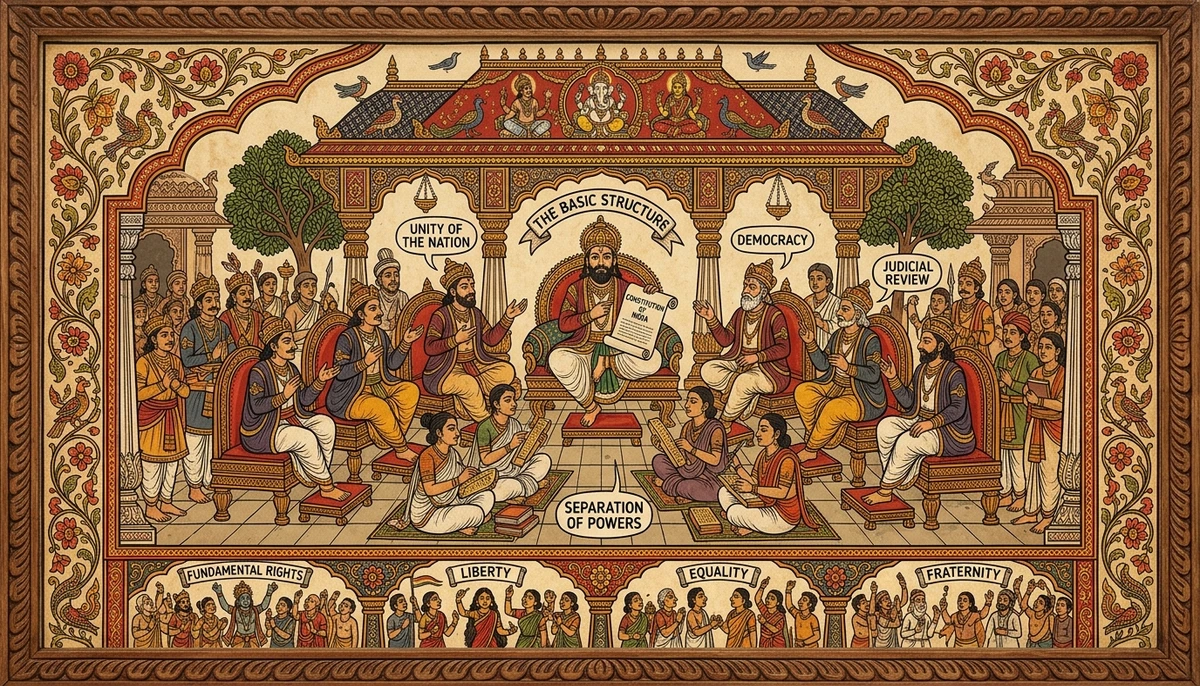
The judgement was delivered on April 24, 1973. The bench was fractured. Eleven separate opinions were delivered. But a majority of seven judges agreed on the central proposition that would define Indian constitutional law for generations: Parliament has the power to amend any provision of the Constitution under Article 368, but it does not have the power to amend the Constitution so as to destroy or damage its basic structure or essential features.
Chief Justice Sikri’s opinion articulated elements of the basic structure: the supremacy of the Constitution, the republican and democratic form of government, the secular character of the Constitution, the separation of powers, and the federal character of the Constitution. Judicial review — the power of courts to test legislation and even constitutional amendments against the Constitution — was itself part of the basic structure.
The majority overruled Golak Nath. Parliament could amend fundamental rights — the 24th Amendment was valid. But Parliament could not use that amending power to destroy the Constitution’s essential identity. The distinction was subtle but decisive: amendment is permissible; abrogation is not.
The Controversy Over the Summary
What happened on the day of the judgement has itself become a matter of historical dispute. A one-paragraph summary was circulated that stated the majority view on the basic structure doctrine. Later, three of the seven judges who had apparently signed it claimed they had not intended to endorse it. The authenticity and interpretation of the summary was contested for years. The uncertainty meant that the doctrine’s contours remained genuinely unclear throughout the 1970s.
The Emergency and the Doctrine’s First Test
The significance of Kesavananda became apparent almost immediately. On June 25, 1975, Indira Gandhi declared a state of Emergency under Article 352, suspending civil liberties and press freedom. The political context was her personal legal crisis — the Allahabad High Court had found her guilty of electoral malpractice and barred her from holding elected office for six years.
In August 1975, the government passed the 39th Amendment, which immunised the Prime Minister’s election from judicial challenge entirely. It also passed the 42nd Amendment, a sweeping set of changes that declared Parliament’s amending power unlimited and placed a wide range of laws beyond judicial scrutiny.
After the Emergency ended and the Janata government came to power, the Supreme Court used Kesavananda to strike down the anti-democratic provisions of these amendments. In Minerva Mills v. Union of India (1980), the Court held that the 42nd Amendment’s attempt to make Parliament’s amending power unlimited was itself a violation of the basic structure — you cannot use a limited amending power to convert it into an unlimited one. Judicial review was confirmed as unamendable.
Legacy: The Global Reach of Unamendability
Kesavananda Bharati has become one of the most discussed constitutional decisions in the world, not because it resolved a narrow dispute but because it confronted a universal problem: if a democracy can amend any provision of its constitution, can it amend itself out of existence? Can a parliament vote to abolish elections, eliminate courts, or remove rights — and call it constitutional because it followed the amendment procedure?
The basic structure doctrine offers one answer: there are features of a constitutional order so fundamental that their destruction is not an amendment at all, but a replacement. A parliament can reform the constitution; it cannot abolish it.
This reasoning has influenced constitutional thought in Bangladesh, Pakistan, Uganda, and Belize, where courts have adopted or considered analogous doctrines. Constitutional scholars in Germany, South Africa, and the United States have examined it as a model for what is sometimes called “unconstitutional constitutional amendments” — the idea that even formally valid amendments can violate constitutional identity.
In India itself, the doctrine remains active. Courts continue to test constitutional amendments and ordinary legislation against the basic structure. What exactly constitutes the basic structure is still being refined case by case, in what is effectively an ongoing constitutional conversation between Parliament and the judiciary.
Swami Kesavananda Bharati, the humble monastery head who lent his name to the case, lived until 2020. He reportedly had little interest in the constitutional drama his petition had set in motion. The doctrine that bears his name, however, has become the strongest judicial shield that Indian democracy possesses.
Vidhi helps legal professionals research landmark Indian and international cases, track constitutional developments, and build arguments grounded in the deepest layers of jurisprudence.